Take a drive through Banana Island in Lagos or the leafy suburbs of Bishopscourt in Cape Town. It’s quiet. Too quiet. You’ll see sprawling mansions with ten-car garages, infinity pools that mirror the sky, and high gates topped with electric wire. But look closer at the windows at night. Most of them are dark.
These aren't homes. They are safety deposit boxes made of brick and mortar.
While millions of people across the continent struggle to find a roof they can afford, Africa’s political elite are playing a different game. They aren't just governing; they are building a private empire , one luxury condo at a time. And they’re doing it with your money.
The Shell Game
How does a minister on a public salary afford a $5 million penthouse in Dubai or a string of townhouses in Johannesburg? They don’t buy them in their own names. That would be too easy to catch.
Instead, they use "proxies" - unemployed relatives, business associates, or even their own children - to sign the paperwork. They set up "shell companies" in places like the British Virgin Islands or the Seychelles. These companies exist only on paper, serving as a digital mask to hide the face of the real owner.
It’s a simple trick: Stolen public funds move from a government contract to a shell company, which then "loans" the money to a local developer to buy a property. By the time the deed is signed, the money looks clean, and the politician has a "legitimate" asset that grows in value every year.
Three Ways They’re Eating the Continent
1. West Africa: The Paper Trail to Nowhere i n Nigeria, the names from the Panama and Pandora Papers read like a roll call of the powerful. Former governors and ministers have been linked to hundreds of properties in London and Dubai. In one famous case, a former oil minister was accused of laundering $1.5 billion into assets including luxury Manhattan condos and yachts. While the lights go out in Lagos, the lights are staying on - secretly - in their apartments abroad.
2. East Africa: Laundering in the Sun Nairobi and Kampala are seeing a massive property boom, but it’s a hollow one. Investigative reports show that " kleptocrats " from war-torn neighbo u rs and local officials are dumping cash into apartments to hide it from regulators. In Uganda, the real estate sector is now considered the highest risk for money laundering. When "dirty money" enters the market, it drives land prices so high that a regular teacher or nurse can no longer afford to live in the city they serve.
3. Southern Africa: The Dictator’s Playground South Africa’s upscale market has become a favo u rite "laundry mat" for leaders from across the region. Relatives of former presidents in the DRC and Equatorial Guinea have been found owning R84 million ($4.5 million) villas in Cape Town. While their citizens at home live on less than $2 a day, these elites are busy choosing the colo u r of the marble in their South African holiday homes.
The Cost of a Quiet Street
We need to stop calling this "investment." It’s a crime with a body count.
Every time a politician stashes $10 million into an empty apartment building, that is $10 million not spent on oxygen tanks for hospitals or books for rural schools. These buildings are "concrete graveyards" - places where public hope goes to die and be buried under high-end flooring.
The real tragedy? We let it happen. Land registries in many African countries are still opaque, and real estate agents are often more interested in their 5% commission than asking where a suitcase full of cash came from. Western capitals like London and New York talk a big game about anti-corruption, but they continue to be the biggest beneficiaries of this stolen wealth.
The Big Question
How long can we ignore the "For Sale" signs on our future?
If a politician’s property portfolio is worth more than their lifetime salary, we shouldn't be asking for their autograph; we should be asking for their receipts. It’s time to pierce the corporate veil and demand that every property owner be named in a public registry. Until then, the skyline will keep rising, but the people will keep falling behind.
Related posts:
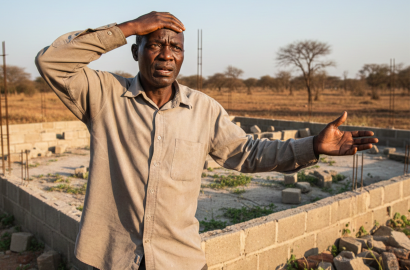
Landing in Lagos or Accra should be a triumph, but for many, it’s a heartbreak. You’ve sent funds for a villa, yet you find only a foundation. This is The Cousin Trap in Africa—where family loyalty meets financial mismanagement. To...
EXPO REAL 2026 is the essential "working fair." In a market where high interest rates are finally becoming a predictable baseline rather than a shock, this event is where the industry stops talking about "potential" and starts signing the checks...
 Escaping the Cousin Trap: Why Building in Africa Requires More Than Family Loyalty
 EXPO REAL 2026: The Power Dynamics: Who Holds the Keys?
 Beyond the Concrete: Why MIPIM 2026 is the Critical Turning Point for Global Capital
 The Concrete Graveyard: How Stolen Billions are Rebuilding the African Skyline
 Houses for Sale in Ghana: The Ultimate 2026 Buyer's Guide